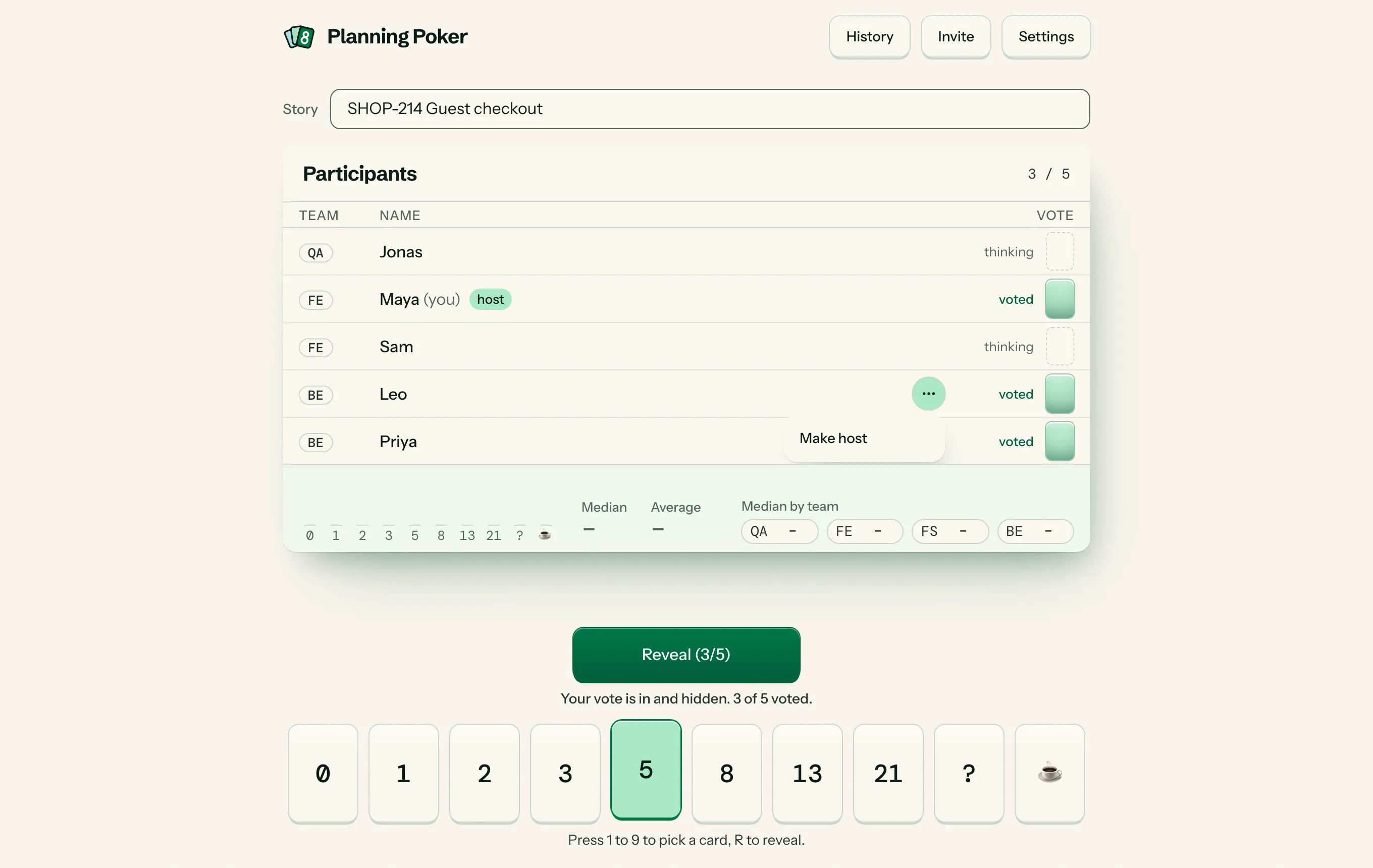
How to play planning poker
Everyone estimates a story on their own, then the team compares. The disagreements are the useful part.
Running a round
- 1
Create a room
Enter your name and click Create room.
- 2
Invite the team
Share the room link in your call or chat.
- 3
Set the story
Type the story title or ticket key so everyone estimates the same thing.
- 4
Vote in private
Everyone picks a card. Votes stay hidden until the reveal.
- 5
Reveal and discuss
Flip all cards at once. The highest and lowest voters explain their reasoning.
- 6
Agree and move on
Re-vote if needed, then start the next story.
Choosing a deck
| Deck | Cards | Best for |
|---|---|---|
| Fibonacci | 0, 1, 2, 3, 5, 8, 13, 21 | The classic. Gaps grow with size, which reflects how uncertain big stories are. |
| Modified Fibonacci | 0, ½, 1, 2, 3, 5, 8, 13, 20, 40, 100 | Adds a half point for tiny tasks and rounder numbers for epics. |
| T-shirt sizes | XS, S, M, L, XL, XXL | Good for roadmap sizing, or for teams new to story points. |
| Custom | Your own cards | Hours, days, or any scale your team already uses. |
Every deck also has a question mark for “I don’t know enough yet” and a coffee card for “let’s take a break”.
Outliers first, two minutes a story
Let the outliers talk first
If most say 5 and one says 13, that person may know a risk the others missed.
Don’t average your way out
A wide spread is a cue to talk. Re-vote after a short discussion.
Timebox the debate
Two minutes a story. Still split? Break the story up or take the higher number.
Invite stakeholders as spectators
They hear the reasoning without moving the numbers.
If the facilitator drops off
The round carries on. Whoever joined earliest becomes the facilitator, with every vote kept. You can also hand the role over from the menu on a teammate’s seat.
Start a room